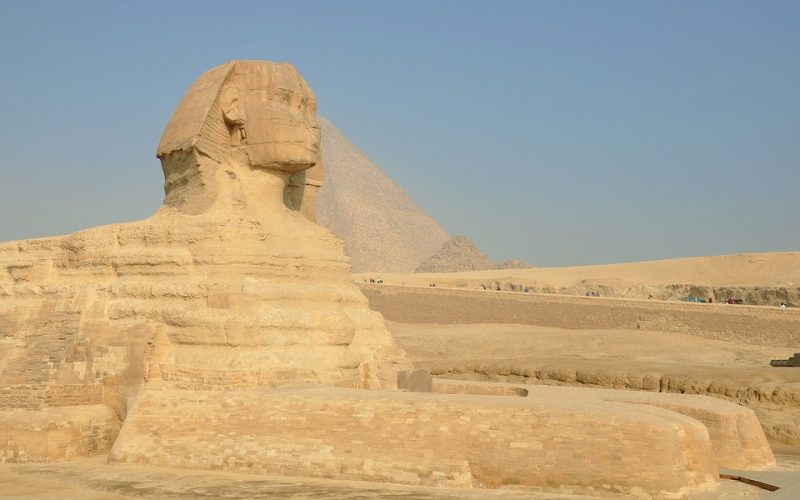
Standing silently at the edge of the Sahara, the Great Sphinx of Giza has watched over Egypt for thousands of years. With the body of a lion and the head of a human, it remains one of the most recognisable monuments on Earth — and one of the most debated. Archaeologists, historians, and enthusiasts continue to argue over its origins, purpose, and meaning, making it as fascinating today as it must have been when it was first carved.
Who built the Sphinx?
Most Egyptologists believe the Great Sphinx was built during the reign of Pharaoh Khafre, around 2500 BC. Khafre was the son of Khufu, the pharaoh behind the Great Pyramid, and ruled during the Fourth Dynasty of the Old Kingdom. The Sphinx sits near Khafre's pyramid complex at Giza, and its face is widely thought to be a portrait of the pharaoh himself. Some scholars, however, argue that it was built by Khufu or even his son Djedefre — the debate is far from settled.
Carved from a single mass of rock
What makes the Sphinx structurally remarkable is that it was carved almost entirely from a single ridge of natural limestone bedrock. Workers cut the stone directly from the Giza plateau, shaping the enormous figure in situ rather than assembling it from separate blocks. The statue stretches approximately 73 metres in length and stands about 20 metres tall — roughly the height of a six-storey building. Additional limestone blocks were used to construct the paws and other outer sections, but the core of the monument is one continuous piece of rock.
The missing nose — and other mysteries
The Sphinx's missing nose is perhaps its most famous feature. Popular legend credits Napoleon's troops with shooting it off during the French campaign in Egypt, but this story does not hold up to scrutiny. Historical sketches made before Napoleon's 1798 expedition clearly show the nose already absent. The more likely explanation is that it was deliberately removed, possibly for religious reasons, sometime between the 3rd and 10th centuries AD. The monument has also lost its original painted decoration; traces of red pigment suggest the face was once painted red, while the body may have been coloured in yellow and blue.
Buried and rediscovered
For much of its history, the Sphinx was buried up to its neck in sand. Ancient Egyptians themselves undertook excavations to uncover it, as recorded on the Dream Stele — a granite tablet placed between the Sphinx's paws by Pharaoh Thutmose IV around 1400 BC. According to the inscription, a young Thutmose fell asleep in the shadow of the Sphinx and was promised the throne of Egypt in a dream if he cleared away the sand. Whether or not the story is true, it tells us that even in antiquity, the Sphinx was already ancient enough to inspire myth.
What does it represent?
The exact purpose of the Sphinx remains a subject of scholarly discussion. The most widely accepted view is that it served as a guardian figure, protecting the nearby royal tombs and temples. Its orientation — facing due east — suggests a connection to solar worship, which was central to ancient Egyptian religion. The lion symbolised power and kingship, while the human head represented intellect and divine authority. Together, they may have embodied the ideal of the pharaoh as a godlike ruler who combined physical strength with wisdom.
Preserving an ancient wonder
Centuries of wind erosion, rising groundwater, and human activity have taken a considerable toll on the Sphinx. Restoration efforts have been ongoing since the 1920s, with large sections of the monument reinforced using a mix of original limestone and modern materials. Egyptian authorities continue to monitor the site closely, balancing the needs of conservation with the demands of millions of tourists each year. Despite everything it has endured, the Sphinx endures — a quiet, commanding presence that continues to inspire curiosity and wonder across the world.